Mr. Goodwin in 2026: A Real Player’s Guide to Bonus Value, First-Week Strategy, and What Actually Matters
Online Sweeps
Feb 9, 2026 • 7 min read
There are two ways to review a sweepstakes platform.
The first is the usual internet template: copy the bonus headline, repeat “great rewards,” add a table, done.
The second is the one experienced players actually use: test how the platform behaves over real sessions, under real constraints, with real human habits.
This is the second kind.
If you’re looking at Mr. Goodwin in 2026 and wondering whether it’s genuinely beginner-friendly, this guide will give you a practical answer — not just whether the offer looks big, but whether the system is usable, sustainable, and worth your time.
The Bonus Looks Huge. Good. Now Let’s Read It Like an Adult.
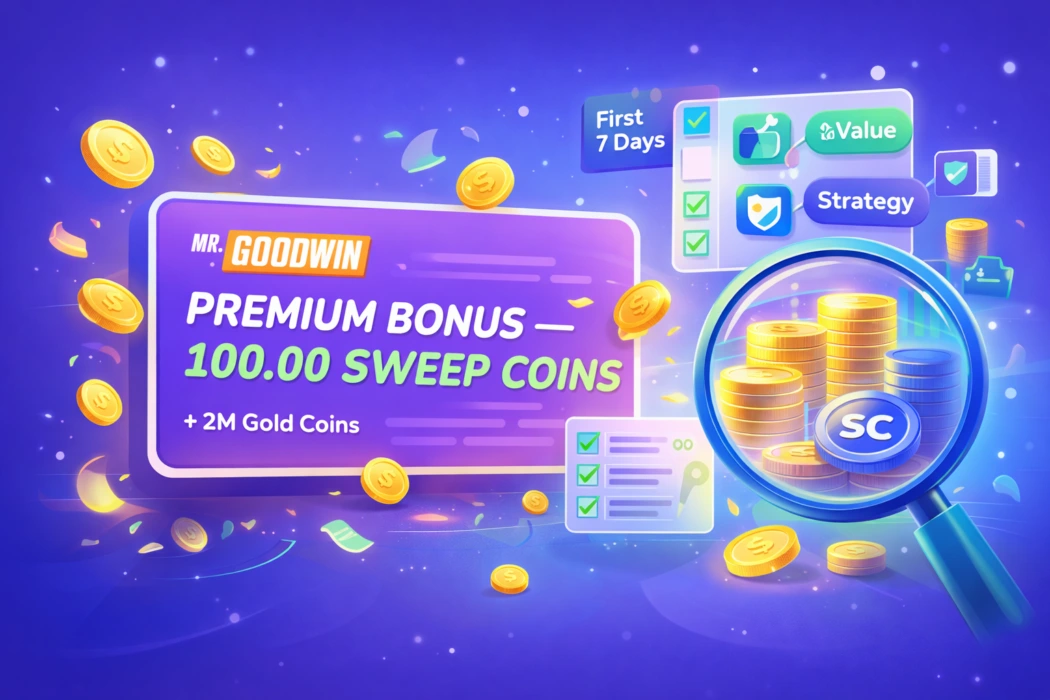
From the bonus creative you shared, the headline structure is:
- Premium Bonus — 100.00 Sweep Coins
- + 2M Gold Coins
- 125K Gold Coins + FREE 1.00 Sweeps Coins for registration
At face value, this is a strong top-funnel package.
But if you’ve been around this space for a while, you already know the rule:
A big number is not the same thing as a big advantage.
The key question isn’t “How big is the welcome promo?”
It’s “How much of that promo turns into useful, controllable value once normal play behavior kicks in?”
That one question separates smart users from disappointed users.
My Position Up Front
Mr. Goodwin can be a very good platform for beginners if they treat the first week as calibration, not a sprint.
Most losses in value do not come from “bad platforms.”
They come from two predictable behaviors:
- Overreacting to a strong first impression.
- Mistaking activity for strategy.
Mr. Goodwin’s promotion is attractive — especially the combined sweep + gold framing — but your outcome depends more on your process than on the banner.
What Makes a Platform Truly Beginner-Friendly?
People say “beginner-friendly” all the time. Usually they mean “looks simple.”
I use stricter criteria. A beginner-friendly platform should provide:
- Clear onboarding language
- Low confusion between currency types and usage
- Predictable session rhythm
- No hidden pressure to overplay
- Enough room to learn without burning through value
Mr. Goodwin scores well on #1 and #3 from the visible structure.
Where beginners struggle is usually #2 and #4 — not because the site is deceptive, but because players rush the learning phase.
The Currency Split: Where Beginners Usually Get Tricked by Their Own Brain
When a welcome package includes multiple coin types, most new users mentally merge all value into one giant pile.
That’s the first strategic mistake.
Different balances can serve very different roles:
- One may be great for exploring game style and pacing.
- Another may matter more for meaningful progression decisions.
- One may feel abundant but have lower strategic leverage in your specific session plan.
If you don’t separate these roles early, your decisions become emotional and inconsistent.
Mr. Goodwin’s package encourages exploration, which is positive.
But beginners should avoid this trap: abundance does not equal efficiency.
The First 7 Days: A Better Plan Than “Claim and Go”
If you’re new to Mr. Goodwin, the best move is not maximizing action.
It’s maximizing signal.
Here’s a practical first-week framework I’d recommend to any serious beginner.
Day 1: Setup and Orientation
Goal: understand flow, not “win the week.”
- Explore platform structure and navigation.
- Identify where rewards are visible and where they’re actually useful.
- Do short sessions only.
- Avoid jumping between too many games/modes.
What to observe:
- Session feel (calm vs chaotic)
- UI clarity under real use
- How easy it is to keep your own limits
Day 2: Currency Discipline
Goal: stop mixing value categories in your head.
- Track what balance you use and why.
- Keep one session objective at a time (test, routine, or event).
- Avoid “just one more cycle” behavior after near misses.
This is the day you build the single most important beginner skill: separating excitement from decision quality.
Day 3: Pattern Testing
Goal: identify your personal friction points.
- Where do you overextend?
- Which moments trigger impulsive choices?
- What session length gives your best clarity?
Most beginners think strategy is about game selection.
In reality, strategy starts with self-management.
Day 4: Controlled Routine
Goal: standardize behavior.
- Same approximate session duration.
- Same entry and exit conditions.
- No reactive switching based on mood.
If your results feel less dramatic today, that’s good.
Stable systems rarely feel dramatic — they feel repeatable.
Day 5: Reward Efficiency Check
Goal: evaluate claim-to-use ratio.
Ask:
- How many rewards did I claim?
- How many actually improved session outcomes?
- How many just increased time on platform?
This one audit instantly separates smart usage from “promo tourism.”
Day 6: Friction Audit
Goal: test practical constraints before emotional investment rises.
- Review redemption conditions with fresh eyes.
- Check whether your real behavior aligns with those pathways.
- Remove assumptions that only existed in your head.
Beginners often delay this step. Don’t.
Day 7: Fit Decision
Goal: decide if Mr. Goodwin fits your profile.
Not “Is it popular?”
Not “Do others say it’s good?”
Not “Did I have one exciting streak?”
Ask:
- Can I run my limits here consistently?
- Is the reward model compatible with my routine?
- Do I enjoy the platform without chasing intensity?
If yes, continue with structure.
If no, move on without drama.
Why Some Players Love Mr. Goodwin — and Others Burn Out Fast
You’ll see opposite opinions online about the same platform. That’s normal.
Mr. Goodwin tends to work well for players who:
- Prefer measured progress over emotional spikes
- Keep clean stop-rules
- Use promotions as tools, not identity
- Track outcomes weekly
It tends to underperform for players who:
- Constantly chase urgency
- Play longer after “almost” moments
- Increase session length because the bonus feels generous
- Refuse to track anything
Same platform. Different behavior architecture.
The Hidden Cost Most Reviews Ignore: Cognitive Load
A platform can be technically generous and still tiring if decision load is too high.
When beginners get tired, they simplify — but in the wrong direction:
- They stop tracking
- They start guessing
- They react instead of planning
Mr. Goodwin’s onboarding presentation is strong enough that many users feel confident too early.
Confidence without process is dangerous.
Your goal is not to feel smart on day one.
Your goal is to make fewer low-quality decisions by day ten.
How to Evaluate the Bonus Like an Expert
Instead of asking “Is 100 Sweep Coins good?”, ask this:
- What percentage of the package produced useful play decisions?
- How stable was my value across sessions?
- Did the bonus reduce pressure, or make me play more impulsively?
- Did I preserve control under excitement?
A good bonus should improve your control-to-value ratio.
If it only increases action volume, it’s not helping you as much as you think.
Practical Mistakes Beginners Make on Mr. Goodwin
Mistake #1: Front-loading too much energy in the first 48 hours
They treat onboarding like a tournament. Then week two collapses.
Mistake #2: Not defining “session success”
If success = “felt exciting,” you’ll overplay.
If success = “followed plan,” your outcomes improve.
Mistake #3: Ignoring fatigue signals
Decision quality drops before you notice it. Stop earlier than your ego wants.
Mistake #4: Chasing consistency through intensity
When results fluctuate, beginners often increase volume.
Usually the better move is reducing noise and tightening routine.
Mistake #5: No weekly review
Without review, you repeat random behavior and call it “experience.”
The 30-Day Method That Actually Works
If you want a serious answer on whether Mr. Goodwin is worth it for you, run this exact 30-day template:
Track:
- Active days
- Session count
- Average session duration
- Rewards claimed
- Rewards meaningfully used
- Times you broke your own rules
- Redemption attempts/outcomes
- End-of-week emotional state (calm, neutral, tilted)
At day 30, ask:
- Is my behavior cleaner than day 1?
- Is value becoming more predictable?
- Does this platform support my style, or constantly fight it?
This gives you a decision based on evidence, not vibes.
Responsible Play, But Actually Practical
“Play responsibly” becomes useful only when it turns into rules:
- Set a fixed session duration before starting.
- Set a non-negotiable stop point.
- Never extend sessions because of near misses.
- Take a break after emotionally noisy sessions.
- Do not chase losses. Ever.
- If you’re tilted, your strategy is automatically invalid for that session.
This is not moralizing. It’s performance hygiene.
Final Expert Verdict on Mr. Goodwin in 2026
Mr. Goodwin’s current bonus profile is strong at first contact: the 100 Sweep Coins headline, 2M Gold Coins framing, and free registration package make it easy to understand why new users are interested.
But the real advantage is unlocked only if the player runs a structured routine.
If you’re a beginner who wants a platform that can support a calm learning curve, Mr. Goodwin can absolutely work.
If your style is impulsive, urgency-driven, and untracked, the same platform will feel less rewarding than the marketing suggests.
So is Mr. Goodwin beginner-friendly?
Yes — for beginners who are willing to behave like operators, not spectators.
That’s the difference between a good first impression and a good long-term experience.
Latest posts

Apr 20, 2026
Best Sweepstakes Casinos in Texas (April 2026): 3 I’ve Tested

Mar 23, 2026
Sites Like LuckyBits Vegas: The 10 Best Casinos Like LuckyBits

Mar 20, 2026
List of Sweepstakes Casinos 2026: Your Ultimate Directory to 215+…

Mar 20, 2026
Sites Like Jackpota: The 10 Best Casinos Like Jackpota

Mar 20, 2026
Sites Like Megabonanza: The 10 Best Casinos Like Megabonanza

Mar 20, 2026
Sites Like High 5 Casino: The 10 Best Casinos Like…

Mar 20, 2026
Sites Like SpeedSweeps: The 10 Best Casinos Like SpeedSweeps

Mar 20, 2026
Sites Like McLuck: The 10 Best Casinos Like McLuck